
Introduction
The software industry has undergone a massive transformation. In the past, success was defined simply by writing code that worked. Today, that is no longer enough. The real challenge lies in how that code is delivered, secured, and managed at scale. This shift has moved the spotlight from individual developers to the systems and leaders who manage the entire delivery lifecycle. Organizations are no longer looking for just technical execution; they are desperate for leadership that understands the “big picture.”
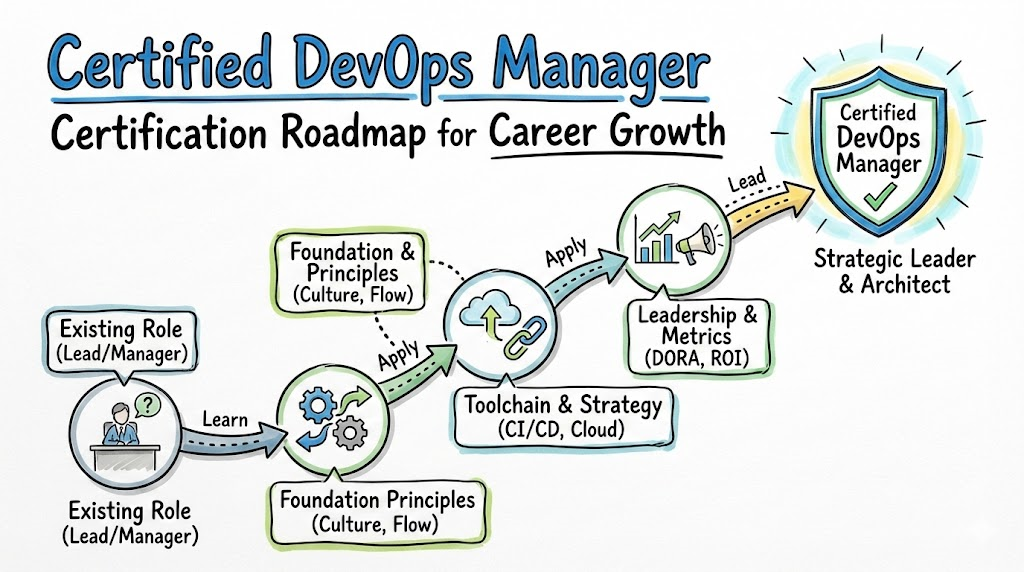
This is where the Certified DevOps Manager designation becomes critical. It represents a shift from being a “doer” to becoming a “leader.” It is not just about knowing how to configure a server; it is about knowing how to structure a team, manage a budget, and align technical output with business goals. This guide is your roadmap to bridging that gap and stepping into a high-impact role.
What is the Certified DevOps Manager Credential?
A Certified DevOps Manager is the architect of an organization’s engineering culture. While a typical engineer focuses on the “how”—such as how to write a script or how to deploy a container—a manager focuses on the “why” and the “what.” This role is responsible for the overall strategy. You are the person who decides which tools to buy, how to structure the team for maximum efficiency, and how to measure success using data rather than gut feelings. It validates that you have the maturity to oversee people, processes, and technology simultaneously.
Why It Matters in the Modern Ecosystem
We are living in an era of complexity. Cloud computing, automation, AI, and security threats are evolving daily. Without a competent manager to orchestrate these moving parts, teams often fall into chaos. You might have great developers, but if they are blocked by poor processes, their talent is wasted. A Certified DevOps Manager ensures that the “assembly line” of software delivery is smooth, secure, and cost-effective. In markets ranging from the tech hubs of Bangalore to Silicon Valley, this ability to bring order to chaos is the most valuable skill set you can possess.
The Strategic Value of Certification
For ambitious engineers and managers, certification is more than a piece of paper; it is a signal of trust.
- Standardization: It proves to the world that you speak the global language of DevOps, not just the local dialect of your current company.
- Credibility: It demonstrates that you have been tested against a rigorous standard and understand best practices that work across different industries.
- Career Acceleration: It is the fastest way to signal that you are ready to move from individual contribution to strategic leadership, opening doors to higher salary brackets and decision-making roles.
Certification Overview & Strategy
| Track | Level | Who it’s for | Prerequisites | Skills Covered | Recommended Order |
| Management | Professional | Lead Engineers, Managers, Architects | 3+ years in Tech | Leadership, CI/CD Strategy, ROI, Metrics, Culture | Take after Foundation |
Provider: devopsschool
Why Choose DevOpsSchool?
When selecting a training partner, you need an institution that understands the reality of the job market. DevOpsSchool stands out because they do not just teach from a textbook; they focus on “employability” and “practical application.”
- Real-World Context: Their curriculum is built by practitioners who are currently working in the field, so you learn techniques that are actually being used today, not theory from ten years ago.
- Community Support: They offer a robust ecosystem where you can connect with mentors and peers, which is invaluable when you are stuck on a difficult concept or looking for a job referral.
- Focus on Engineering: Unlike other management courses that are purely theoretical, DevOpsSchool ensures you understand the underlying engineering, giving you the confidence to lead technical teams with authority.
Deep-Dive: The Certified DevOps Manager
What is this certification?
This program is a comprehensive leadership course designed to transform technical experts into management professionals. It covers the entire spectrum of DevOps, but from a “governance” perspective. You learn how to design pipelines, not just build them. You learn how to manage cultural transformation, ensuring that your Dev and Ops teams stop fighting and start collaborating. It is the MBA of the DevOps world.
Who should take this certification?
- Senior DevOps Engineers: If you feel stuck doing the same technical tasks and want to move up the ladder to manage the team you used to be a part of.
- Project Managers: If you are struggling to understand the technical jargon your team uses and want to manage cloud-native projects more effectively.
- Engineering Managers: If you need a structured framework to improve your team’s deployment speed and quality.
Skills you will gain
- Strategic Roadmap Design: You will learn how to look at a company’s current chaotic state and draft a clean, step-by-step plan to modernize their software delivery over 6 to 12 months.
- Metric-Driven Management: You will master DORA metrics (Deployment Frequency, Lead Time, Change Failure Rate, MTTR). You will learn how to use these numbers to prove to your bosses that your team is improving.
- Cultural Transformation: You will learn specific techniques to break down “silos.” You will understand how to incentivize collaboration so that developers care about operations and operations care about code quality.
- ROI & Budgeting: You will gain the financial literacy to calculate the Return on Investment for automation tools. You will be able to answer the question, “If we spend $10,000 on this tool, how much money will we save?”
Real-world projects you should be able to do (Expanded)
- Conduct a DevOps Assessment: You should be able to walk into any company, interview the teams, look at their tools, and write a report detailing exactly where their bottlenecks are and how to fix them.
- Design a CI/CD Policy: You will be able to create a governance document that dictates how code moves from a developer’s laptop to production, including all the necessary security checks and approval gates.
- Lead a Post-Mortem: You will be able to run a meeting after a system crash where the goal is not to blame someone, but to find the root cause and fix the process so it never happens again.
Preparation Plan
- 7–14 Days Plan (Foundation): Spend this time reading the core literature. Books like The Phoenix Project are essential. Understand the “Three Ways of DevOps” (Flow, Feedback, Continuous Learning). Familiarize yourself with the syllabus topics.
- 30 Days Plan (Toolchain Strategy): You don’t need to master the code, but you need to know the architecture. Study how Jenkins, Docker, Kubernetes, and Terraform fit together. Focus on “Architecture Patterns” rather than syntax.
- 60 Days Plan (Scenarios & Metrics): This is for deep practice. Work on case studies. Ask yourself, “If the server goes down during a Black Friday sale, what do I do?” Practice calculating metrics and presenting them in a dashboard format.
Common mistakes to avoid
- Ignoring Culture: The biggest mistake is thinking DevOps is just about tools. If you install Jenkins but don’t change how people work, you will fail. Focus on the people first.
- Over-Engineering: Do not try to automate everything at once. Learn to prioritize. A good manager knows that sometimes a simple manual process is better than a complex, fragile automated one.
- Forgetting the Business: Never lose sight of the fact that the goal is to sell a product or service. If your “cool” automation doesn’t help the business make money or save time, it is useless.
Best next certification after this
- Same Track: Certified DevOps Architect – for those who want to design the massive, complex systems that run global enterprises.
- Cross-Track: Certified DevSecOps Professional – to specialize in the high-stakes world of security and compliance.
- Leadership: SRE Foundation – to understand the Google-style approach to operations and reliability.
Choose Your Learning Path
1. DevOps Path
Best for: Generalists and Future CTOs.
This path is the backbone of the industry. It gives you a holistic view of the entire software lifecycle. You become the “bridge builder” who connects all the different technical islands within a company.
2. DevSecOps Path
Best for: Security-Conscious Engineers.
Security is no longer a separate department; it is everyone’s job. This path teaches you how to automate security checks so that they happen instantly every time code is saved. It is about shifting security “to the left” (earlier in the process).
3. Site Reliability Engineering (SRE) Path
Best for: Problem Solvers and Scalability Experts.
If you enjoy keeping massive systems running smoothly, this is for you. SREs treat operations as a software problem. You will focus on “Error Budgets” and “Service Level Objectives” to balance reliability with the need for speed.
4. AIOps / MLOps Path
Best for: Data Scientists and Futurists.
As AI models move from research labs to real-world apps, they need to be managed. This path teaches you how to build pipelines that automatically retrain and deploy AI models, ensuring they stay accurate over time.
5. DataOps Path
Best for: Data Engineers and Analysts.
Data teams often suffer from slow, manual processes. This path applies DevOps principles to data analytics. You learn how to automate data cleaning, testing, and delivery so that business leaders get their reports instantly.
6. FinOps Path
Best for: Cloud Architects and Finance Managers.
The cloud is expensive. This path is strictly about money. You learn how to read complex cloud bills, identify waste (like servers running when no one is using them), and optimize costs without hurting performance.
Role → Recommended Certifications Mapping
- DevOps Engineer: You need the Certified DevOps Professional. This solidifies your core technical skills and proves you can handle the tools.
- Site Reliability Engineer (SRE): Go for the SRE Practitioner. It validates your ability to maintain uptime and manage incidents.
- Platform Engineer: The Kubernetes & Cloud Native Specialist is ideal, as platform engineering is heavily reliant on container orchestration.
- Cloud Engineer: Focus on the Certified Cloud Provider (AWS/Azure/GCP) certifications to master the specific infrastructure you work on.
- Security Engineer: The Certified DevSecOps Professional is non-negotiable. It bridges the gap between your security knowledge and the developer’s world.
- Data Engineer: The Certified DataOps Professional will help you streamline your data pipelines.
- FinOps Practitioner: The Certified FinOps Professional is the standard for cost management roles.
- Engineering Manager: The Certified DevOps Manager is your key to unlocking executive potential.
Next Certifications to Take
To keep your career moving forward, you must always be learning.
- One Same-Track Certification: If you are on the management track, look into Agile Coach or Scrum Master certifications. These complement your DevOps management skills by giving you deeper insight into project management methodologies.
- One Cross-Track Certification: Every manager should understand security. Taking a DevSecOps Foundation course will give you the vocabulary to speak confidently with your security team and understand their concerns.
- One Leadership-Focused Certification: Consider Site Reliability Engineering (SRE) Foundation. Even if you are not an SRE, understanding the concepts of “Reliability” and “SLOs” is crucial for any engineering leader.
Training & Certification Support Institutions
DevOpsSchool
This institution is a powerhouse for practical, job-oriented training. They offer comprehensive courses that cover the entire DevOps landscape. Their focus is on ensuring you have the “muscle memory” to do the job, not just pass a test.
Cotocus
Cotocus is known for its high-end consulting and corporate training. They excel at helping organizations make the shift to the cloud. Their training is often rigorous and designed for professionals who need to solve complex enterprise problems.
ScmGalaxy
A veteran in the industry, ScmGalaxy has been around since the early days of Configuration Management. They are an excellent resource for understanding the foundational history and evolution of DevOps tools.
BestDevOps
This platform is great for curated learning paths. They simplify the overwhelming number of tools and technologies into clear, step-by-step guides that help you avoid “analysis paralysis.”
devsecopsschool.com
This is a niche academy dedicated entirely to the intersection of Development, Security, and Operations. If your goal is to become a security expert in a cloud-native world, this is the specialist provider you need.
sreschool.com
Focused strictly on reliability, this school teaches the Google-born discipline of SRE. It is the best place to go if you want to master the art of keeping large-scale systems online and healthy.
aiopsschool.com
As AI becomes central to IT operations, this school leads the charge. They provide cutting-edge training on how to use machine learning to automate the detection and resolution of IT incidents.
dataopsschool.com
For data professionals, this is the hub for learning how to build robust, automated data pipelines. They teach you how to apply CI/CD principles to the world of Big Data.
finopsschool.com
With cloud costs soaring, this school provides essential training on Cloud Financial Management. They teach the specific skills needed to bring accountability to cloud spending.
FAQs Section
General Certification Inquiries
- Is the Certified DevOps Manager exam difficult?
It is designed to be challenging because it tests your judgment, not just your memory. You will face scenario-based questions where you have to choose the “best” solution among several “good” ones. - How much time should I set aside for study?
For a working professional, we recommend a consistent schedule of 1 hour per day for about 6 to 8 weeks. Consistency is key to retaining the concepts. - Do I need to be a coding expert?
No. You do not need to be a developer, but you must be “code-literate.” You need to understand what the code does and how the development process works, but you won’t be writing production code yourself. - What is the sequence for taking these exams?
We recommend starting with the DevOps Foundation to get your terminology right, then moving to the Professional level for tool knowledge, and finally the Manager level for strategy. - What is the real career value?
Beyond the salary bump, the real value is confidence. You will walk into meetings knowing exactly what needs to be done, backed by a framework that is proven to work. - Can I take the exam from home?
Yes, almost all modern certifications offer online proctoring, allowing you to take the exam from the comfort of your home office. - Do these certifications expire?
Most have a validity period of 2 to 3 years. This is actually a good thing, as it forces you to stay updated with the rapidly changing technology landscape. - Will this help me get a job abroad?
DevOps is a global standard. A certification from a recognized body is valid in the US, Europe, Australia, and beyond. - What job roles does this open up?
It prepares you for roles like DevOps Manager, Release Manager, Cloud Architect, and even VP of Engineering in smaller startups. - How do I verify my status?
You will receive a digital badge that is cryptographically signed. You can put this on your LinkedIn profile, and recruiters can click it to verify your achievement instantly. - What is the passing score?
Typically, you need to score around 70% to pass, though this can vary slightly depending on the specific exam version. - Why not just get a degree?
University degrees are great for theory, but they are often years behind the industry. Certifications are updated annually to reflect the tools companies are using right now.
Specific “Manager” Track Inquiries
- Why choose the Manager track over the Engineer track?
Choose this if you enjoy “big picture” thinking. If you prefer designing the system rather than tightening the bolts, the Manager track is for you. - Does it cover specific tools like AWS?
It focuses on cloud strategy rather than specific vendor buttons. You learn concepts that apply to AWS, Azure, and Google Cloud equally. - Will this help me manage remote teams?
Yes, a key part of the curriculum covers collaboration tools and cultural practices that are essential for managing distributed, remote-first teams. - Is there a practical lab?
Yes, the best programs include labs where you have to simulate management decisions, such as handling a deployment failure or prioritizing a backlog. - How does it help with “Soft Skills”?
It places a huge emphasis on empathy, communication, and negotiation—skills that are often the difference between a project succeeding or failing. - Do I need to know Kubernetes?
You need to understand why Kubernetes is used and what business value it brings, but you don’t need to be an expert in configuring its control plane. - Is this certification recognized in India?
Absolutely. India is a global hub for DevOps talent, and this certification is highly regarded by major service-based and product-based companies here. - What is the main takeaway?
The ability to deliver software faster, with higher quality, and with happier teams. That is the core value proposition.
Testimonials
Suresh
“I was always the ‘go-to’ guy for fixing servers, but I struggled to lead the team. This course gave me the framework to organize our work. Now, we don’t just put out fires; we prevent them.”
Anita
“The module on DORA metrics was an eye-opener. I started tracking our deployment frequency, and within three months, I could show management exactly how much we had improved. It changed the conversation completely.”
Rahul
“I was skeptical about a management course, thinking it would be all fluff. I was wrong. The focus on ROI and budgeting helped me speak the language of our finance team, which got us the budget for new tools.”
Meera
“Transitioning from a developer to a manager was scary. The Certified DevOps Manager program gave me a roadmap. I learned how to support my team without micromanaging them.”
Kabir
“The best part was the community. Connecting with other managers facing the same problems helped me realize I wasn’t alone. The strategies I learned for culture building have completely transformed our team dynamic.”
Conclusion
Becoming a Certified DevOps Manager is a pivotal moment in your career. It marks the transition from being a skilled technician to becoming a strategic leader. In a world where every company is becoming a software company, the ability to manage the software delivery lifecycle is a superpower.
You have the experience. You have the ambition. Now, you need the framework. By following this guide and committing to a structured learning path with a trusted partner like DevOpsSchool, you are not just getting certified; you are future-proofing your career. Start your journey today.
