
Introduction
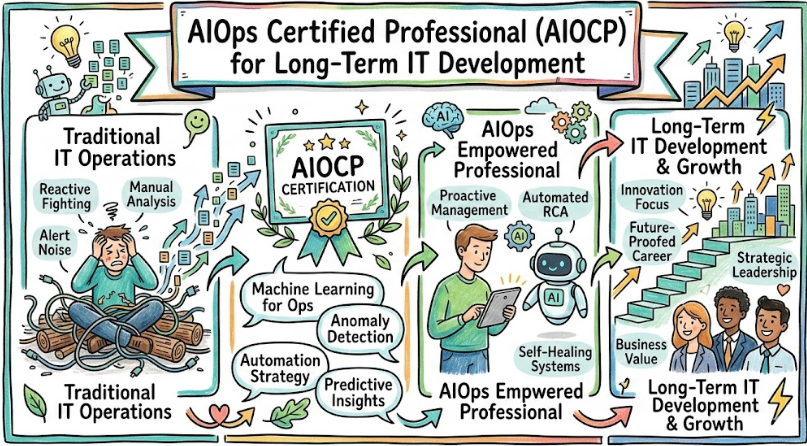
The AIOps Certified Professional (AIOCP) is recognized as a professional-tier certification that merges the disciplines of data science and IT operations. This program is not merely centered on the adoption of new software; it is focused on the fundamental redesign of operational workflows. Through this curriculum, the use of big data, machine learning, and advanced analytics is mastered to automate the identification and resolution of complex IT issues. It is regarded as a critical milestone for engineers who seek to evolve from traditional monitoring to intelligent, self-healing system management.
Why it Matters in Today’s Ecosystem
In the contemporary software and automation ecosystem, system complexity has reached a point where manual intervention is often too slow or prone to error. Downtime is no longer tolerated, and the cost of operational failure is higher than ever. AIOps matters because it allows for the processing of millions of logs and metrics in real-time, identifying patterns that are invisible to the naked eye. By implementing these intelligent frameworks, the burden of “alert fatigue” is removed, and the focus of engineering teams is shifted toward high-value innovation rather than constant firefighting.
The Importance of Certifications for Growth
For engineers and managers alike, certifications are viewed as an essential validation of professional competence. In a global market where technical standards are constantly changing, a formal credential ensures that a standardized body of knowledge is maintained. For the individual, it provides a clear competitive edge during hiring and promotion cycles. For the organization, a certified workforce is seen as a lower-risk investment, as these professionals have been trained to follow industry-recognized best practices in automation and system reliability.
Certification Overview Table
| Track | Level | Who it’s for | Prerequisites | Skills Covered | Recommended Order |
| AIOps | Master/Professional | DevOps & SRE Teams | IT Ops & Basic Scripting | Data Modeling, ML for Ops, Automation | Following DevOps/SRE Core |
Why choose DevOpsSchool?
When professional growth is considered, the choice of a training provider is paramount. DevOpsSchool is selected by thousands of professionals because the curriculum is developed by experts who possess a deep understanding of real-world operational challenges. The training is structured to provide a balance between deep technical theory and practical, lab-based execution. Every learner is supported by a comprehensive ecosystem of resources, ensuring that the transition to AIOps is handled with confidence and technical accuracy.
Certification Deep-Dive: AIOCP
What is this certification?
The AIOCP is a professional program designed to teach the application of AI and Machine Learning to the management of IT systems. It is structured around the core pillars of data ingestion, pattern discovery, and automated response.
Who should take this certification?
This track is recommended for Cloud Engineers, Platform Engineers, and Site Reliability Engineers who are responsible for maintaining large-scale distributed systems. It is also highly valuable for Engineering Managers who must plan and oversee the integration of AI into their team’s daily workflows.
Skills You Will Gain
- Big Data Management: Techniques for collecting and normalizing massive datasets from logs, metrics, and traces are acquired.
- Algorithmic Troubleshooting: The use of machine learning models to perform root cause analysis with high precision is learned.
- Noise Reduction: Strategies for filtering out redundant alerts and focusing on critical system events are implemented.
- Predictive Maintenance: The ability to forecast potential system failures before they impact the user experience is developed.
- Automated Remediation: Workflows that allow the system to trigger its own repairs based on algorithmic triggers are mastered.
Real-World Projects Post-Certification
- Anomalous Behavior Detector: A project is completed where a machine learning model is trained to identify unusual traffic spikes that indicate a security breach or system leak.
- Intelligent Event Aggregator: A system is built that groups hundreds of related microservice errors into a single, high-level incident report.
- Dynamic Capacity Planner: An automation script is developed that scales cloud infrastructure based on seasonal data patterns rather than simple CPU thresholds.
Preparation Plan
- 7–14 Days Plan: The core architecture of AIOps is explored. Initial focus is placed on understanding the different types of data (logs, metrics, traces) and how they are ingested into a central platform.
- 30 Days Plan: Practical labs are prioritized. Basic machine learning concepts are applied to historical system data to practice the identification of baseline behaviors and deviations.
- 60 Days Plan: Full-scale automation and remediation scenarios are executed. Mock examinations are completed to ensure that both the technical skills and the conceptual framework of the AIOCP are fully internalized.
Common Mistakes to Avoid
- Neglecting Data Cleansing: It is often overlooked that AI is only as effective as the data provided. If log quality is poor, the results will be unreliable.
- Over-Automating Too Early: A mistake is made when complex remediation is attempted before the detection phase is fully accurate. A phased approach is always recommended.
- Ignoring Cultural Change: AIOps requires a shift in how teams view their roles. The human element must be managed as carefully as the technical implementation.
Best Next Certification After This
- Same Track: Advanced AIOps Implementation Specialist.
- Cross-Track: MLOps Professional (for managing the lifecycle of AI models).
- Leadership / Management: Strategic IT Leadership or Digital Transformation Director.
Choose Your Learning Path
The DevOps Specialist Path
This path is intended for those who wish to integrate intelligence into the software delivery pipeline. The focus is placed on using AI to identify deployment risks and automate the rollback of unstable releases. It is best for professionals who operate in high-velocity release environments.
The DevSecOps Specialist Path
Security is the primary focus of this path. It involves the use of machine learning to detect zero-day vulnerabilities and unusual network patterns. It is ideal for engineers who are tasked with maintaining the integrity of cloud-native applications.
The Site Reliability Engineering (SRE) Path
This path is chosen by those responsible for the ultimate uptime of a system. AIOps is used here to manage error budgets and automate the response to infrastructure outages. It is recommended for those managing massive, globally distributed services.
The AIOps / MLOps Path
This is a highly technical path for data-centric engineers. It combines the disciplines of operations and data science, focusing on the maintenance and scaling of the AI models themselves. It is best for those looking to work at the cutting edge of IT innovation.
The DataOps Path
The reliability of data pipelines is the core of this path. It focuses on using automation to ensure that data is delivered accurately and securely across the organization. It is suited for data engineers and database administrators.
The FinOps Path
This path is designed for those managing the financial health of the cloud. AI is utilized to forecast spending and identify areas where cloud costs can be reduced through automated resource optimization. It is ideal for cost analysts and cloud architects.
Role → Recommended Certifications Mapping
The following mapping is provided to guide professionals in their certification journey:
- DevOps Engineer: Certified DevOps Professional followed by AIOCP to master intelligent delivery.
- Site Reliability Engineer (SRE): Certified SRE Professional and AIOCP for advanced incident management.
- Platform Engineer: Kubernetes Specialist combined with AIOCP for building self-healing platforms.
- Cloud Engineer: Professional Cloud Architect paired with AIOCP for multi-cloud automation.
- Security Engineer: DevSecOps Professional and AIOCP for AI-driven threat hunting.
- Data Engineer: DataOps Professional and AIOCP for intelligent data pipeline management.
- FinOps Practitioner: Certified FinOps Professional and AIOCP for predictive cost modeling.
- Engineering Manager: Digital Transformation Lead and AIOCP for strategic automation oversight.
Next Certifications to Take
Once the AIOCP is successfully achieved, the professional development journey is continued through:
- Same-track Recommendation: AIOps Expert Certification (for large-scale architectural design).
- Cross-track Recommendation: MLOps Certification (to manage the engineering side of AI models).
- Leadership-focused Recommendation: Executive Leadership in IT Automation (to drive organizational change).
Training & Certification Support Institutions
- DevOpsSchool: This institution is recognized for providing intensive, mentor-led workshops that focus on the practical application of AIOps and DevOps principles in enterprise environments.
- Cotocus: High-end consulting and technical training are offered here, with a specific focus on cloud-native transformations and advanced automation strategies.
- ScmGalaxy: A vast repository of community knowledge is maintained, offering thousands of free resources and tutorials for engineers seeking to stay current with modern tools.
- BestDevOps: The focus is placed on career-oriented training, providing lab-intensive courses designed to prepare students for high-level roles in IT operations.
- Devsecopsschool.com: A dedicated platform for learning the integration of security automation throughout the development lifecycle is provided.
- Sreschool.com: All aspects of reliability engineering, from performance tuning to automated incident response, are covered in this specialized school.
- Aiopsschool.com: This is the primary destination for professionals seeking the AIOCP certification, offering the most comprehensive curriculum in the field of intelligent operations.
- Dataopsschool.com: Strategies for managing and automating high-velocity data pipelines are taught here by industry veterans.
- Finopsschool.com: The financial management of cloud resources is the focus, with training provided on cost optimization and data-driven governance.
FAQs Section
General Career FAQs
- Is the AIOCP program considered difficult?
The program is structured to be challenging but manageable for those with a solid background in IT operations and a basic understanding of data concepts. - How much time is required to prepare for certification?
A commitment of 6 to 10 hours per week over a period of two to three months is generally sufficient for most candidates. - What are the prerequisites?
A foundational knowledge of cloud platforms, Linux administration, and any scripting language (such as Python) is recommended. - In what order should these certifications be taken?
It is usually advised that the basics of DevOps or SRE are mastered before the specialized AIOps track is started. - What is the professional value of this certification?
Increased visibility to recruiters, higher salary potential, and the ability to lead high-impact automation projects are commonly reported outcomes. - Which job roles benefit the most?
Senior engineers in DevOps, SRE, and cloud roles, as well as engineering managers, find the most immediate benefit. - Is hands-on practice included in the training?
Yes, a major portion of the learning process is dedicated to virtual labs and the completion of real-world projects. - Are these credentials recognized globally?
Yes, the skills and the certification itself are highly respected in major technology markets across India, Europe, and the US. - Can someone without a coding background take this?
Basic scripting skills are needed, but one does not need to be a full-stack software developer to succeed. - How long is the certification valid?
Most professional certifications in this field are valid for two to three years, after which a renewal or advanced exam is recommended. - Do I need to be an expert in math?
A basic understanding of statistics and logic is helpful, but the course is designed to be accessible to IT professionals. - What is the first step to starting?
Interested individuals are encouraged to review the official syllabus and attend an introductory webinar to understand the scope of the program.
AIOCP Specific FAQs
- Are specific AIOps tools taught in the course?
The principles are taught using industry-standard platforms for observability and machine learning to ensure broad applicability. - Does the course include machine learning model building?
The focus is placed on the application of existing models to operational data rather than building new algorithms from scratch. - How does this certification help with on-call duties?
By teaching noise reduction and automated response, the frequency and duration of on-call incidents are significantly reduced. - Is predictive maintenance a major focus?
Yes, learning to identify the early warning signs of system failure is a core component of the AIOCP curriculum. - Is multi-cloud data aggregation covered? Techniques for pulling and analyzing data from multiple providers (like AWS and Azure) are fully explored.
- Does the program cover big data platforms?
The management and ingestion of high-velocity log data into platforms like Elasticsearch or similar are covered. - Are there practical projects required for completion?
Yes, the certification process often involves the completion of a capstone project that demonstrates technical mastery. - How does AIOps help in cloud cost saving?
It is taught that through predictive analytics, over-provisioned resources can be identified and scaled down automatically.
Testimonials
Advait
“The transition from manual monitoring to a data-driven approach was made simple by this program. The ability to manage alerts effectively has completely changed how our team operates.”
Ishita
“A huge boost in professional confidence was gained after completing the practical labs. The projects provided a realistic look at how AI can solve the most difficult system errors.”
Kunal
“As a manager, the strategic overview of AIOps was invaluable. I can now plan our department’s automation roadmap with a much higher degree of technical accuracy.”
Nisha
“The mentorship provided was truly exceptional. Every technical question was answered with practical, real-world examples that made the complex topics much easier to understand.”
Zaid
“The impact on our system uptime was immediate. By applying the predictive maintenance strategies learned in the AIOCP, several major outages were prevented in the first month.”
Conclusion
The pursuit of the AIOps Certified Professional (AIOCP) certification is regarded as a vital step for any IT professional who wishes to remain relevant in an increasingly automated world. The move toward intelligent operations is no longer a luxury; it is a necessity for managing the scale and complexity of modern digital business. Through this program, the skills needed to turn data into a competitive advantage are acquired. Long-term career success is ensured for those who take the initiative to master these advanced technologies today. A strategic learning plan is encouraged to take full advantage of the opportunities presented by this exciting field.
