
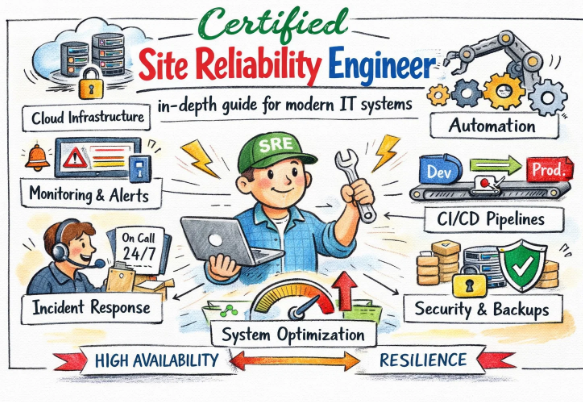
Introduction
Reliability is considered the important part of any digital service. If a website or an application is not available, then even the most beautiful code is considered useless by the users. A better way to manage these systems is offered through the principles of Site Reliability Engineering. In this guide, the path to becoming a Certified Site Reliability Engineer is explored in a simple and clear way. All the necessary steps for career growth in this field are shared here.
What is Certified Site Reliability Engineer
The Certified Site Reliability Engineer is a professional title given to those who treat operations as a software engineering task. Instead of manual work, automation is used to keep systems running. It is a mindset where code is written to manage and scale infrastructure.
Through this certification, a deep understanding of system uptime and performance is gained. It is not just about using tools; it is about learning how to build systems that can heal themselves. Reliability is made a core part of the development process rather than an afterthought.
Why it Matters Today?
The modern world is powered by digital platforms that are expected to work 24/7. When a service goes down, the impact on business and user trust is immediate and severe. Because systems are becoming more complex with cloud and microservices, traditional management is no longer enough.
Expertise is required to handle these large-scale challenges. Companies in India and across the globe are looking for professionals who can ensure stability while still allowing for fast updates. In a fast-moving market, the ability to maintain high availability is considered a top priority for every organization.
Why Certified Site Reliability Engineer Certifications are Important
A standardized way to measure skill and knowledge is provided by these certifications. It is used to prove that an engineer has moved beyond basic concepts and is ready for real-world production challenges. Many professionals learn things in a random way, but a certification ensures a structured and complete learning path is followed.
Trust is built within an engineering team when members are certified in industry-best practices. It serves as a clear roadmap for career advancement, helping individuals move into more senior and specialized roles. For many employers, a certification is seen as a mark of quality and commitment to the field.
Why Choose SREschool?
A very practical approach to learning is offered by SREschool. The curriculum is built by experts who have dealt with some of the largest system outages in the industry. Complex technical ideas are broken down into simple, manageable pieces that anyone can understand.
Continuous support is provided to every student to ensure that the concepts are fully mastered. Real-world lab exercises are included so that skills are practiced in environments that mimic actual production. By choosing this provider, a solid foundation is laid for a successful career in reliability engineering.
Certification Deep-Dive: Certified Site Reliability Engineer
What is this certification?
The Certified Site Reliability Engineer is a professional credential that focuses on the engineering aspects of service reliability. It is designed for those who want to use automation to manage high-traffic systems and reduce manual effort.
Who should take this certification?
This certification should be taken by software developers, system administrators, and cloud engineers. It is also very valuable for engineering managers who need to understand how to build and lead reliability-focused teams.
Certification Overview Table
| Track | Level | Who it’s for | Prerequisites | Skills Covered | Recommended Order |
| DevOps | Intermediate | Developers | Linux Basics | CI/CD, Scripting | 1 |
| DevSecOps | Advanced | Security Pros | DevOps Basics | Security Automation | 2 |
| SRE | Expert | Reliability Pros | Cloud Knowledge | SLOs, Automation | 3 |
| AIOps/MLOps | Specialist | Data Scientists | Python/ML | Predictive Monitoring | 4 |
| DataOps | Specialist | Data Engineers | SQL/Databases | Pipeline Reliability | 5 |
| FinOps | Management | Finance/Tech | Billing Basics | Cost Optimization | 6 |
Skills You Will Gain
- The ability to define and monitor Service Level Objectives (SLOs) is developed.
- Knowledge of using Service Level Indicators (SLIs) to measure system health is gained.
- Automated incident response systems are designed and implemented.
- Manual and repetitive tasks, known as “toil,” are reduced through scripting.
- Strategies for capacity planning and performance tuning are mastered.
- The culture of blameless post-mortems is used to learn from system failures.
Real-World Projects to be Completed
- A complete observability dashboard is built to track application performance.
- A self-healing system is created to automatically restart failed services.
- A chaos engineering experiment is conducted to find hidden weaknesses in a system.
- An error budget policy is designed and managed for a live production application.
Preparation Plan
7–14 Days Plan (Rapid)
The core vocabulary and basic concepts of SRE are reviewed every day. Focus is placed on the definitions of SLIs, SLOs, and error budgets. A few practice questions are solved to get a feel for the exam format.
30 Days Plan (Standard)
One hour of study is performed each evening. All the practical labs provided in the curriculum are completed at least once. Real-world case studies of system outages are read to understand expert problem-solving.
60 Days Plan (Deep Dive)
A deep dive into distributed systems and cloud architecture is conducted. Every project and lab is repeated until the tasks can be performed without any help. Mock exams are taken weekly to ensure a high level of confidence for the final test.
Common Mistakes to Avoid
- Theoretical knowledge is memorized but the practical lab exercises are skipped.
- The importance of the “SRE culture” and communication is ignored.
- Too much focus is placed on a single tool instead of the overall methodology.
- The exam is taken without completing enough mock tests to track progress.
Best Next Certification After This
- Same Track: Certified Site Reliability Architect.
- Cross-Track: Certified DevSecOps Professional.
- Leadership / Management: Certified Engineering Manager.
Choose Your Learning Path
DevOps Path
This path is chosen by those who want to focus on the speed of software delivery. The goal is to automate the entire path from the developer’s laptop to the production server. It is ideal for engineers who enjoy working with CI/CD tools and pipelines.
DevSecOps Path
Security is made a priority in every step of the development process. Automated security checks are integrated into the pipeline so that bugs are found early. This is best for professionals who want to protect systems from cyber threats.
Site Reliability Engineering (SRE) Path
The focus is placed on the stability and performance of systems. Code is used to manage and scale infrastructure so that services are always available. This path is perfect for those who love solving complex stability challenges.
AIOps / MLOps Path
Artificial intelligence is used to monitor and manage IT operations. Machine learning models are deployed to predict and prevent system failures before they occur. This is recommended for data-driven engineers who want to lead in the age of AI.
DataOps Path
The goal is to ensure that data flows quickly and reliably through an organization. Pipelines are built to handle large amounts of information with high quality. This path is best for data engineers and architects who manage data at scale.
FinOps Path
Cloud costs are monitored and optimized to ensure that the company is spending money wisely. Technical performance is balanced with the financial budget. This is ideal for those who want to manage the financial side of cloud technology.
Role → Recommended Certifications Mapping
| Role | Recommended Certification |
| DevOps Engineer | Certified DevOps Professional |
| Site Reliability Engineer | Certified Site Reliability Engineer |
| Platform Engineer | Certified Platform Specialist |
| Cloud Engineer | Certified Cloud Architect |
| Security Engineer | Certified DevSecOps Professional |
| Data Engineer | Certified DataOps Specialist |
| FinOps Practitioner | Certified FinOps Associate |
| Engineering Manager | Certified Technical Leader |
Next Certifications to Take
Same-track:
The Certified Chaos Engineering Professional is recommended for those who want to master failure testing.Systems are intentionally broken in a controlled way to find weaknesses before they happen in real life.This is considered the best next move for an SRE professional who wants to reach an expert level.
Cross-track:
The Certified DevSecOps Professional is suggested to ensure that security is integrated into reliability work.Vulnerability checks are added to the automated pipeline to protect user data and system integrity.This combination of stability and security is highly valued by modern enterprises worldwide.
Leadership:
The Certified Engineering Manager program is advised for those moving into strategic roles.The focus is shifted from managing technical tasks to leading high-impact engineering teams.Professional growth is achieved by learning how to set goals and measure team efficiency.
Training & Certification Support Institutions
DevOpsSchool
Training and support for various modern technical roles are provided here. A strong community of learners is maintained to help everyone grow in their careers. Practical skills and hands-on labs are emphasized in every program offered.
Cotocus
Corporate training and individual coaching are the main focus of this group. Professionals are helped to transition into high-paying engineering roles through specialized tracks. The curriculum is kept practical, simple, and easy to follow for all.
ScmGalaxy
A vast library of tutorials, guides, and community forums is managed by this platform. Assistance is provided for mastering configuration management and automation tools used in the industry. It is a well-known resource for continuous learning and skill updates.
BestDevOps
Specialized bootcamps for SRE and DevOps are conducted at this institution. A focus is maintained on the skills that are most in demand by top employers today. Mentorship is provided by people with deep industry experience to ensure career success.
devsecopsschool.com
This platform is dedicated to the integration of security into the development lifecycle. Specialized courses for security-minded engineers are offered to bridge the gap between dev and ops. It is a key place for those wanting to master DevSecOps.
sreschool.com
This is the primary center for Site Reliability Engineering education globally. Everything needed to pass the Certified Site Reliability Engineer exam is found on this platform. The curriculum is built to support both beginners and experienced professionals.
aiopsschool.com
Training on how to use artificial intelligence for IT operations is delivered here. Future-ready skills for automated monitoring and predictive ops are taught to engineers. It is ideal for those who want to lead in the new era of automation.
dataopsschool.com
The reliability and speed of data delivery are the core focuses of this educational platform. Professionals are taught how to build and maintain complex and scalable data pipelines. It is a top choice for anyone entering the data engineering field.
finopsschool.com
Cloud financial management is the main topic of study provided here. Skills for optimizing cloud spending and creating accountability are shared with technical and finance teams. It is designed to help companies control their growing cloud budgets.
FAQs Section
- What is the difficulty level of the Certified Site Reliability Engineer exam?
The exam is considered to be of a moderate to high level of difficulty. A solid mix of theoretical study and practical lab experience is required to be successful.
- How much time is generally needed for preparation?
Most candidates find that 4 to 8 weeks of consistent study are enough. This time is used for reading the material and practicing the tasks in the provided labs.
- Are there any prerequisites for this certification?
A basic understanding of Linux and at least one programming language is helpful. No advanced degrees are required to start this learning journey.
- In what order should these certifications be taken?
The DevOps certification is usually completed first by most professionals. This is followed by the SRE certification once basic automation skills are mastered.
- What is the career value of being a certified SRE?
The value is very high because SREs are in high demand at top-tier tech companies. Higher salaries and better job titles are commonly reported by certified individuals.
- Which job roles can be pursued after getting certified?
Roles such as SRE, Platform Engineer, and Systems Architect can be applied for. Many cloud operations and infrastructure roles also require these specific skills.
- Is this certification recognized in India?
Yes, it is highly respected by many large companies and successful startups in India. It is also recognized by organizations and recruiters across the globe.
- How is the exam conducted?
The exam is conducted online through a secure and proctored platform. This allows learners to take the test from their own location without any travel.
- Can an engineering manager benefit from this knowledge?
Yes, it helps managers understand how to set realistic reliability goals for their teams. It also improves communication and collaboration with technical staff.
- How often is the training material updated?
The material is updated regularly to ensure it matches the latest changes in the technology field. This keeps the certification relevant for current job requirements.
- Is study support provided during the training?
Yes, mentors are available to answer questions and help with any difficult lab exercises. A strong community of students also provides mutual support throughout the course.
- Does the certification help in getting a promotion?
Yes, having a certified expert-level skill set often makes a professional stand out during internal reviews. It shows a commitment to high standards and reliability.
Additional FAQs: Certified Site Reliability Engineer
- What is the primary focus of the SRE role?
The primary focus is to ensure that a digital service is available and performs well for the users.
- Is coding a mandatory part of this certification?
Yes, coding is used to automate repetitive tasks and build tools for managing large systems.
- What is an “Error Budget” in simple terms?
It is a defined amount of downtime that a service is allowed to have without losing the trust of the users.
- How is toil defined by SRE professionals?
Toil is defined as manual work that is repetitive, lacks long-term value, and can be replaced by automation.
- Are “Post-mortems” included in the curriculum?
Yes, learning how to analyze system failures without blaming individuals is a core skill taught in the program.
- What are SLIs and SLOs?
These are the metrics and targets used to measure how well a system is meeting its reliability goals.
- Is cloud knowledge required for this program?
Yes, since most modern systems run in the cloud, understanding cloud architecture is very important for an SRE.
- Does SRE replace the traditional DevOps role?
No, SRE is seen as a specific and practical way to implement DevOps principles with a heavy focus on stability.
Testimonials
Arjun
A very clear understanding of system stability was gained through this course. The practical labs were very helpful for my daily tasks at work.
Sita
The career path was made very simple to understand by the mentors. My confidence in managing large systems has grown significantly after being certified.
Vikram
Complex technical ideas were explained in a very human way. I finally understood how to balance new features with system reliability.
Meera
The focus on automation has saved me hours of manual work every week. This certification is a great asset for any platform engineer.
Karan
A deep insight into incident management was provided during the training. I now feel ready to take on more senior roles in my company.
Conclusion
The Certified Site Reliability Engineer program is shown by the success of those who complete it. A path toward long-term career growth is opened when these skills are mastered. Strategic learning and careful preparation are encouraged for every engineer who wants to succeed. As more services move to the digital world, the need for experts who can maintain them will only increase. A bright future is built by those who choose to invest in these critical skills today.

