
Introduction
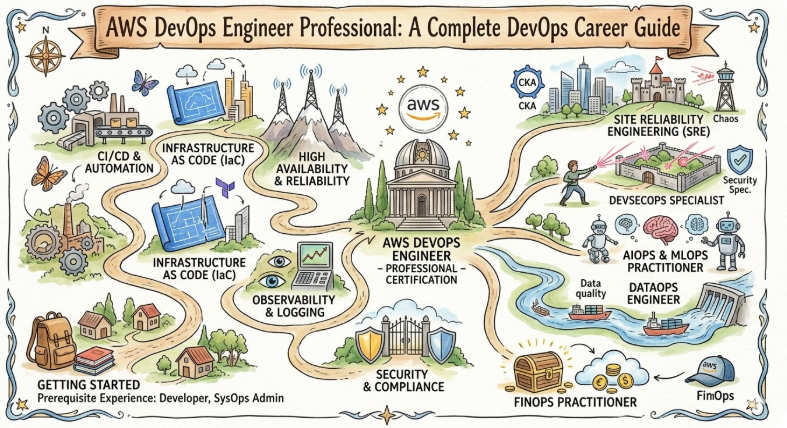
The AWS DevOps Engineer – Professional credential is known as one of the most rigorous certifications offered by Amazon Web Services. It is designed to validate the ability to automate the testing and deployment of AWS infrastructure and applications. By achieving this, a high level of expertise in managing complex, distributed systems is demonstrated. It is not merely a test of tool knowledge; it is an evaluation of an engineer’s ability to design systems that are resilient, scalable, and secure from the moment the first line of code is written.
Why it matters in today’s ecosystem
In the current tech era, software is expected to be delivered at a rapid pace without compromising on stability. Manual processes are being replaced by automated pipelines, and traditional infrastructure is being converted into code. This certification is valued because it proves that an engineer can lead these transformations within an organization. Companies are no longer looking for people who can just “fix” servers; they are looking for architects who can build systems that fix themselves through advanced automation and proactive monitoring.
The Importance of Certifications for Engineers and Managers
By engineers, certifications are used as a structured way to gain deep knowledge that might not be found in daily tasks. It forces a move out of the comfort zone of familiar tools and into the broader AWS ecosystem. For managers, a benchmark is provided to ensure that the team is built on a foundation of industry best practices. Reliability is increased, and risks are mitigated when certified professionals are leading the cloud strategy, ensuring that expensive architectural mistakes are avoided during the growth phase of a project.
Certification Overview Table
| Track | Level | Who it’s for | Prerequisites | Skills Covered | Recommended Order |
| AWS DevOps | Professional | DevOps & Cloud Engineers | Strong AWS Foundation | CI/CD, HA, Governance, SDLC | After Associate |
Provider: DevOpsSchool
Why Choose DevOpsSchool?
When a professional-level journey is started, the right guidance is required to navigate the complexities of advanced cloud architecture. DevOpsSchool is chosen by thousands of learners because a hands-on, practical approach is followed. Lessons are not just read from a book; they are experienced through real-world labs and industry-driven scenarios that mimic actual production environments. The complex concepts of AWS are broken down into simple, manageable steps, and a supportive community of mentors is provided to ensure that every doubt is cleared promptly, allowing the learner to progress with confidence.
Certification Deep-Dive
What is this certification?
This is an advanced-level exam where the ability to design and manage automated systems is tested under pressure. A deep understanding of high availability, multi-region deployments, and disaster recovery on the AWS platform is required. It is widely considered a badge of technical maturity for those who oversee large-scale cloud operations.
Who should take this certification?
This path is intended for those who have spent significant time—usually two or more years—provisioning and managing cloud environments. It is ideally suited for DevOps engineers, systems administrators, and platform engineers who want to reach the highest level of their profession and be recognized as domain experts in automation and cloud governance.
Skills you will gain
- Continuous delivery systems are implemented and managed to ensure code moves from developer machines to production without manual friction.
- Security controls and compliance validation are automated, ensuring that every deployment meets strict corporate and legal standards.
- Monitoring, logging, and metrics are deployed at scale to provide total visibility into system health and performance.
- Highly available and self-healing infrastructures are designed to automatically recover from hardware or software failures.
- Operational processes are automated to improve efficiency, allowing teams to focus on innovation rather than repetitive maintenance tasks.
Real-world projects to be performed after certification
- Global CI/CD Pipelines: A multi-region pipeline is built to handle traffic from different parts of the world, ensuring that updates are delivered smoothly across all zones.
- Deployment Strategies: Blue/Green and Canary deployment strategies are configured to allow for zero-downtime updates, where new features can be tested on a small group of users before a full rollout.
- Centralized Governance: A framework is established to manage security and compliance across hundreds of AWS accounts using AWS Organizations and Service Control Policies.
- Self-Healing Systems: Automated incident response systems are created to detect system anomalies and perform corrective actions without the need for a human engineer to intervene.
Preparation Plan
7–14 Days Plan (The Intensive Review)
If the platform is already used daily for production tasks, this time is spent on reviewing the exam domains. Practice questions are solved to identify gaps in knowledge, and whitepapers on high availability and fault tolerance are read to polish existing expertise.
30 Days Plan (The Balanced Path)
In the first two weeks, structured video lessons are watched, and official documentation is studied for core services. The remaining two weeks are dedicated to performing hands-on labs and focusing on complex services like AWS Config, AWS Systems Manager, and multi-account strategies.
60 Days Plan (The Comprehensive Journey)
For those who want a deep understanding of every service, the first month is used to build manual projects. In the second month, everything is recreated using automation tools like CloudFormation or Terraform. This is followed by a month of rigorous exam simulation to ensure readiness for the professional-level questions.
Common mistakes to avoid
- Underestimating Security: The importance of security and fine-grained IAM roles is often underestimated, yet it is a major part of the professional exam.
- Ignoring Governance: Multi-account management through AWS Organizations is sometimes ignored by candidates who only work in single-account environments.
- Time Management: Scenario-based questions are not practiced enough, leading to time management issues during the actual exam, where long, complex stories must be read and analyzed quickly.
Best next certification after this
- Same track: AWS Certified Security – Specialty to deepen the focus on automated protection.
- Cross-track: AWS Certified Solutions Architect – Professional to understand broader design patterns.
- Leadership: Certified Kubernetes Administrator (CKA) to master container orchestration alongside cloud automation.
Choose Your Learning Path
1. DevOps Path
This path is taken by those who wish to master the entire software delivery lifecycle. Automation is the primary focus here, moving from code commits to production monitoring with zero manual steps.
2. DevSecOps Path
Security is integrated into every stage of the pipeline in this path. It is chosen by those who want to ensure that vulnerability scanning and compliance checks are performed before code ever reaches a live environment.
3. Site Reliability Engineering (SRE) Path
System stability and scalability are prioritized. This path is followed by engineers who want to build systems that can withstand massive traffic spikes while maintaining a high “error budget” and reliability score.
4. AIOps / MLOps Path
Artificial intelligence is used to improve IT operations. This path is designed for those who want to automate the training, deployment, and monitoring of machine learning models within a standard DevOps framework.
5. DataOps Path
Data pipelines are managed with the same rigor and automation as software pipelines. It is chosen by data engineers who want to improve the speed of data analytics while ensuring data quality and lineage.
6. FinOps Path
Cloud spending is optimized in this path. Financial accountability is brought to the technical teams to ensure that the cloud is used efficiently and that the business value of every dollar spent on AWS is maximized.
Role → Recommended Certifications Mapping
- DevOps Engineer: AWS DevOps Engineer – Professional.
- SRE: AWS DevOps Professional + CKA.
- Platform Engineer: AWS Solutions Architect – Professional.
- Security Engineer: AWS Certified Security – Specialty.
- Data Engineer: AWS Certified Data Engineer – Associate.
- FinOps Practitioner: FinOps Certified Practitioner.
- Engineering Manager: AWS Cloud Practitioner + Project Management basics.
Next Certifications to Take
For those who have completed the AWS DevOps Professional journey, the following are recommended:
- Same-track: AWS Certified Security – Specialty.
- Cross-track: Certified Kubernetes Administrator (CKA).
- Leadership-focused: TOGAF for enterprise architecture or PMP for project governance.
Training & Certification Support Institutions
DevOpsSchool
A leading platform where professional-level training is provided through interactive sessions. High-quality labs and expert mentorship are offered to help candidates pass the exam on the first attempt by focusing on real-world scenarios.
Cotocus
Specialized consulting and training are provided here for corporate and individual learners. The focus is placed on modernizing the workforce and preparing them for advanced cloud challenges through customized learning paths.
ScmGalaxy
A massive resource of technical content is shared on this platform for the global community. It is widely used by engineers to learn about build automation, release engineering, and advanced configuration management.
BestDevOps
Tailored courses are offered to help individuals transition into specialized cloud roles. Practical knowledge is prioritized over theoretical learning to ensure that students are job-ready from day one.
devsecopsschool.com
A focused environment is created for learning security in the context of DevOps. Automated compliance, vulnerability scanning, and threat modeling are taught in great detail by industry experts.
sreschool.com
Everything related to system reliability and performance is covered here. Engineers are taught how to manage large-scale production environments with minimal downtime using advanced monitoring and incident response.
aiopsschool.com
The intersection of AI and IT operations is explored here. Intelligent automation techniques are taught to modern engineers who want to use machine learning to predict and prevent system failures.
dataopsschool.com
The principles of DevOps are applied to the world of data management. Higher data quality and faster delivery cycles are achieved through their specialized training programs.
finopsschool.com
The art of cloud cost management is taught here. It is ensured that organizations get the most value out of their cloud investments by training engineers to balance performance with cost.
FAQs Section
General Career & DevOps FAQs
- How is the transition to a DevOps mindset viewed by industry leaders?
A shift toward “Infrastructure as Code” is seen as essential for modern business. Reliability is naturally increased when manual interventions are removed from the production path. - What long-term value is provided by this certification?
A position of technical authority is often gained within the company. It is seen as a sign of maturity in handling the most complex cloud systems that AWS offers. - Is the difficulty of the exam justified by the career growth?
While the exam is notoriously hard, the rewards are found in the high-level leadership and architectural roles that become accessible to the badge holder. - How much time is usually allocated for study?
Around three months of consistent, focused effort is typically suggested for a deep and lasting understanding of the professional domains. - Are any prerequisites mandatory?
No formal exams are required before taking the Professional test, but a very strong foundation in cloud basics is expected and usually necessary for success. - How is the team culture influenced by a certified expert?
Standardized best practices are introduced to the workflow, which leads to better communication between development and operations teams. - Can a move into management be supported by this path?
Yes, better strategic decisions are made by managers who understand the technical reality and limitations of the cloud. - What role is played by automation in reducing technical debt?
Repeatable processes are built, which prevents the accumulation of manual errors and “quick fixes” that eventually slow down a project. - Is a global career assisted by this credential?
Standardized skills are recognized worldwide, making international transitions and remote work opportunities much easier to secure. - How is troubleshooting handled at the professional level?
Root causes are identified through advanced logs and metrics rather than just fixing visible symptoms, leading to a more stable environment. - Is the investment in training programs worthwhile?
Months of trial and error are saved when a structured roadmap and expert guidance are followed during preparation. - What impact is seen on delivery speed?
Faster and more frequent releases are achieved when pipelines are properly optimized, allowing the business to respond to market changes instantly.
AWS DevOps Engineer – Professional Specific FAQs
- Why is multi-region mastery prioritized?
Global availability must be maintained for modern apps. The ability to handle regional failures without user impact is a critical skill tested in this exam. - How is the “Professional” level different from the “Associate” level?
The “why” and “when” of using tools are emphasized rather than just the “how.” The focus shifts to long-term architectural stability. - Is serverless deployment a major focus?
Yes, a large portion of the exam is dedicated to managing Lambda, API Gateway, and Step Functions at an enterprise scale. - How is security integrated into the pipeline?
Automated guardrails are built using AWS Config and IAM, ensuring that security compliance is checked with every single code change automatically. - Is knowledge of AWS Organizations required?
Yes, managing security policies and billing across multiple accounts is a key domain that every professional engineer must master. - What importance is placed on self-healing systems?
Systems are designed to detect and fix their own failures using health checks, Lambda triggers, and auto-scaling, ensuring maximum uptime. - Are third-party integrations discussed?
Yes, how AWS native tools interact with external systems like GitHub or Jenkins is often tested through complex scenario-based questions. - How is cost-optimization handled?
Financial impact is considered during the initial design phase to ensure that cloud resources are not wasted and that the architecture remains cost-effective.
Testimonials
Aman
A huge improvement in my technical confidence was experienced after this certification. The complex automation projects in my company are now handled with ease and a much higher degree of accuracy.
Sanya
The roadmap provided by this path was exactly what was needed for my career growth. The transition to a Senior Cloud Engineer role was made much smoother by the professional-level knowledge gained.
Vikram
The practical labs were the highlight of my learning journey. Real-world problems were solved during training, which helped immensely in my daily job as a DevOps professional.
Elena
A deeper understanding of security and compliance was gained. I can now ensure that our deployments are not only fast but also completely secure and compliant with global standards.
Rajesh
Managing a large team is easier when the underlying technology is understood at this professional depth. This certification is recommended for every technical lead and engineering manager.
Conclusion
The AWS DevOps Engineer – Professional certification is more than just a credential; it is a transformative journey for any technical professional. By mastering the pillars of automation, security, and scalability, a future-proof career is built in an industry that never stops evolving. Strategic planning and continuous learning are encouraged for anyone looking to lead the next generation of cloud innovation and excellence.

