
Introduction
Moving to the cloud feels like renting a massive, high-tech office building where you only pay for the space you use. You can spin up new servers in seconds, scale up storage with a click, and build powerful apps without buying a single piece of physical hardware.
However, this flexibility comes with a hidden trap. Because it is so easy to create cloud resources, it is just as easy to forget about them.
Companies often receive their monthly cloud bills with a shock. Servers run all weekend when nobody is working, development teams build massive environments they never shut down, and nobody knows who is responsible for the charges.
This financial chaos is why businesses need FinOps. It turns cloud cost management from a monthly panic attack into a structured, proactive business practice.
What Is FinOps?
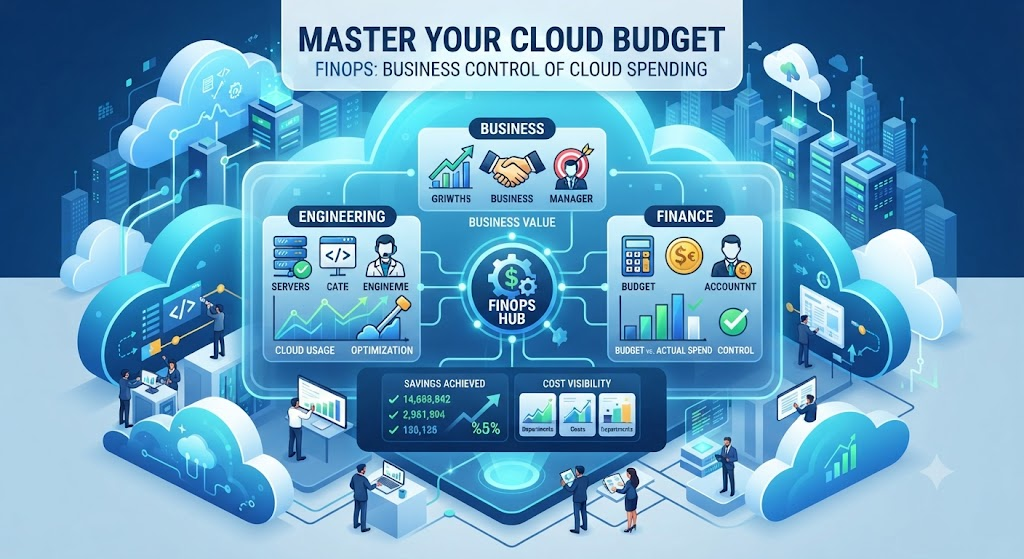
FinOps stands for Cloud Financial Operations. It is not a piece of software or a single department. Instead, it is a cultural practice and operational framework that brings financial accountability to the variable spend model of cloud computing.
Think of FinOps as a bridge connecting two different worlds:
- Engineers want speed, performance, and the freedom to build great things quickly.
- Finance teams want predictability, budgeting, accuracy, and cost control.
FinOps gets these groups talking the same language.
Why Does It Matter?
Without FinOps, cloud costs usually outgrow business growth. Companies end up paying for idle capacity, over-provisioned databases, and abandoned test environments. FinOps matters because it ensures every dollar spent in the cloud drives actual business value rather than evaporating into digital waste.
How Cloud Spending Gets Out of Hand
To understand why FinOps is necessary, look at how traditional IT budgeting works versus the cloud.
In the past, buying a physical server required months of planning, approvals, and capital expenditure. People thought carefully before buying.
In the cloud, anyone with a credit card can launch a powerful server cluster.
Common Causes of Cloud Waste
- Idle Resources: Leaving development and staging servers running 24/7 even when developers go home for the weekend.
- Over-Provisioning: Choosing massive, expensive server sizes just to be safe, even though the application only uses a fraction of that power.
- Forgotten Storage: Accumulating old backups, snapshots, and temporary data files that sit in expensive storage tiers forever.
- Lack of Accountability: When a cloud bill arrives marked simply as “General Engineering,” nobody feels responsible for optimizing it.
The Three Phases of the FinOps Lifecycle
FinOps is an ongoing journey rather than a one-time project. The FinOps Foundation organizes this journey into three continuous phases: Inform, Optimize, and Operate.
1. Inform
Visibility is the first step. You cannot fix what you cannot see.
- What it means: Giving teams the ability to see exactly where cloud money is going down to the individual project, team, or feature.
- Why it matters: Allocation creates awareness. When engineers see the financial impact of their architecture choices, they start making smarter decisions.
2. Optimize
Once you know where the money goes, you look for ways to trim the fat without hurting performance.
- What it means: Sizing down oversized servers, buying discounted capacity commitments (like reserved instances), and deleting unused storage.
- Why it matters: Optimization provides quick financial wins and lowers the baseline cost of running your systems.
3. Operate
This is where cost management becomes part of everyday company culture.
- What it means: Setting up ongoing policies, tracking Key Performance Indicators (KPIs), and aligning cloud spending goals with business revenue growth.
- Why it matters: Cloud usage changes constantly. Operating ensures that cost control does not fade away after the initial cleanup.
Practical Example: How FinOps Works in Real Life
Imagine a growing e-commerce startup called ShopFast.
The Problem: ShopFast launched a new mobile app on the cloud. Business is booming, but their monthly cloud bill jumped from $5,000 to $35,000 in just six months. The founders are panicking because they do not know if this growth is sustainable.
The FinOps Approach:
- Allocation: The company implements cloud tagging. Every server and database is labeled with the team name that created it (e.g.,
team=checkoutorteam=recommendations). - Discovery: The finance and engineering teams review the dashboard together. They discover that the
recommendationsteam is running database clusters that are ten times larger than necessary during night hours. - Action: The engineers set up an automated schedule to scale down those databases at night when traffic is low. They also purchase a one-year commitment discount for their steady baseline traffic.
- Result: The monthly bill drops by $10,000 without any loss in application speed or customer experience.
Key Benefits of Implementing FinOps
- Faster Innovation: When finance trusts engineering to manage budgets responsibly, approval processes speed up.
- Predictable Budgets: Companies can forecast future cloud spending accurately, preventing nasty end-of-month surprises.
- Maximized Value: Instead of just cutting costs blindly, FinOps focuses on unit economics—measuring cloud spend against revenue generated (e.g., cloud cost per active customer).
Common Mistakes to Avoid
1. Treating FinOps Solely as a Cost-Cutting Exercise
If leadership views FinOps only as a way to slash budgets, engineering teams will push back. FinOps is about maximizing business value, which sometimes means spending more money on cloud resources if those resources directly drive revenue and customer growth.
2. Leaving Finance Out of the Loop
Expecting engineers to handle finance alone—or expecting finance teams to understand complex cloud infrastructure without help—is a recipe for failure. FinOps requires genuine collaboration.
3. Relying Solely on Manual Reviews
Checking cloud bills once a month is too late. By the time you notice an accidental spike in spending, the damage is already done. Effective FinOps relies on real-time anomaly alerts.
FinOps Decision Framework
Use this simple framework to guide your cloud cost management strategy:
- Step 1: Establish Visibility: Tag all cloud resources so you know who owns what.
- Step 2: Set Guardrails: Implement budget alerts that notify teams when spending crosses certain thresholds.
- Step 3: Eliminate Obvious Waste: Hunt down idle resources, unattached storage volumes, and abandoned test environments.
- Step 4: Right-Size Infrastructure: Match server sizes to actual usage metrics rather than guesswork.
- Step 5: Leverage Discounts: Explore reserved instances, savings plans, and spot instances for workloads that tolerate interruption.
- Step 6: Review Continuously: Make cloud cost review a regular part of engineering sprint planning.
Key Terms
- Cloud Tagging: Adding metadata labels (like owner, department, or project name) to cloud resources to track who is spending what.
- Right-Sizing: The process of matching the size of a cloud resource to its actual performance requirements to avoid paying for idle capacity.
- Reserved Instances: A billing discount model where a company commits to using a specific type of cloud resource for a 1- or 3-year term in exchange for a lower hourly rate.
- Idle Resources: Cloud servers or storage volumes that are turned on and costing money but performing no useful work.
- Unit Economics: Measuring cloud costs relative to a business metric, such as cost per transaction or cost per active user.
- Anomaly Detection: Automated alerts that trigger immediately when cloud spending spikes unexpectedly above normal patterns.
FAQs
What is the main goal of FinOps?
The main goal of FinOps is to bring financial accountability to cloud computing, helping businesses maximize the business value of every dollar spent in the cloud rather than just cutting costs blindly.
Who is responsible for FinOps in an organization?
FinOps is a collaborative effort. It involves cloud engineers who build systems, finance professionals who manage budgets, and business leaders who set company strategy.
Is FinOps only for large enterprises?
No. While large enterprises manage massive cloud bills, startups and mid-sized businesses benefit greatly from establishing good FinOps habits early before bad architecture and untracked spending get out of hand.
How does FinOps differ from traditional IT budgeting?
Traditional IT budgeting relies on long-term capital planning for fixed hardware. FinOps deals with variable, pay-as-you-go cloud operational expenses that change dynamically based on usage.
Does FinOps mean slowing down development?
Not at all. When done right, FinOps gives engineering teams clear financial guardrails so they can innovate quickly and safely without needing manual budget approvals for every action.
What tools are used in FinOps?
FinOps teams use native cloud provider dashboards (like AWS Cost Explorer or Azure Cost Management) as well as specialized third-party FinOps and cost-monitoring software platforms.
Conclusion
Cloud computing offers incredible speed and flexibility, but financial discipline is required to keep it from becoming an uncontrolled expense. FinOps transforms cloud cost management from an afterthought into a strategic advantage.
By uniting finance and engineering, gaining clear visibility into resource usage, and eliminating waste continuously, businesses can innovate faster, protect their profit margins, and ensure their cloud investment fuels sustainable growth.

