Introduction
Modern IT systems generate massive streams of operational data every second. Traditional monitoring tools often drown teams in false alerts, making it difficult to find the root cause of a system outage before users notice.
Artificial Intelligence for IT Operations, commonly known as AIOps, solves this challenge by combining big data and machine learning to automate incident detection and resolution.
For IT professionals, mastering this domain offers a direct path to higher-value roles. However, navigating the landscape of training programs, vendor-neutral credentials, and specific platform badges can feel confusing.
This guide breaks down what AIOps credentials involve, which skills matter most, and how to choose the right learning path for your career.
What Is AIOps?
AIOps stands for Artificial Intelligence for IT Operations. It refers to the practice of using machine learning algorithms and advanced data analytics to automate operational workflows.
Traditional IT management relies on static thresholds. If a server reaches 90 percent CPU usage, an alert fires. This approach generates constant noise and alert fatigue for system engineers.
AIOps systems analyze historical data and real-time logs together. They establish dynamic baselines, separate minor blips from critical failures, and automatically correlate related events across complex cloud environments.
Why It Matters
Modern applications run across distributed microservices, multi-cloud platforms, and containerized clusters. Human operators cannot manually parse millions of log lines during an outage. AIOps platforms sift through the noise to pinpoint root causes in seconds, drastically reducing downtime and operational costs.
How AIOps Works
Understanding the underlying mechanics helps you evaluate different credential programs and choose the right specialization.
1. Data Ingestion
The system collects operational data from disparate sources. This includes server logs, application performance monitoring traces, network traffic flows, and ticketing history.
2. Pattern Matching and Anomaly Detection
Machine learning models examine incoming streams against historical norms. Instead of triggering an alarm at a fixed threshold, the algorithm identifies unusual behavioral patterns that signal an impending failure.
3. Noise Reduction and Correlation
Independent alerts triggered by a single underlying fault are grouped into a single incident ticket. This stops engineers from chasing dozens of symptoms while the actual root cause remains hidden.
4. Remediation
Advanced systems can trigger automated playbooks to restart services, scale up container clusters, or reroute network traffic without human intervention.
Key Core Competencies in AIOps
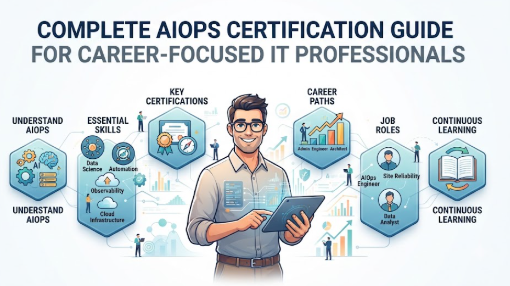
Before pursuing a formal credential, you need to build competence across four essential pillars:
- Data Engineering for IT: Knowing how to ingest, clean, and structure logs, metrics, and traces from diverse cloud environments.
- Machine Learning Fundamentals: Understanding clustering, regression, and anomaly detection models without needing a PhD in data science.
- Observability and Monitoring: Mastering tools like Prometheus, Grafana, Datadog, or Dynatrace that feed data into AI engines.
- Automation and Scripting: Using Python, Terraform, and CI/CD pipelines to execute automated remediation scripts triggered by AI insights.
Popular AIOps and Observability Credentials
While there is no single universal certification that dominates the market like the CISSP in security, several prominent vendor and vendor-neutral programs exist.
| Certification / Program Focus | Primary Target Audience | Core Skill Focus |
| Vendor-Neutral AIOps Foundations | System Administrators, DevOps Engineers | General concepts, incident correlation, data pipelines |
| Platform-Specific Observability Badges (e.g., Datadog, Dynatrace) | Cloud Engineers, SREs | Tool configuration, metric analysis, automated alerts |
| Cloud Provider Machine Learning & DevOps Certifications (AWS, Azure, GCP) | Cloud Architects, Developers | Infrastructure automation, cloud-native monitoring |
Career Impact and Salary Potential
Organizations struggle to find professionals who bridge the gap between traditional system administration and data-driven automation.
- Bridging the Skill Gap: Most traditional sysadmins understand infrastructure but lack machine learning literacy. Conversely, data scientists often lack operational context. AIOps practitioners bridge this divide.
- Role Transitions: System engineers transition into Site Reliability Engineers (SREs) or AIOps Architects, commanding higher compensation packages.
- Efficiency Gains: Certified professionals help enterprises cut mean-time-to-resolution (MTTR) metrics, making them invaluable assets to engineering leadership.
Common Mistakes Professionals Make
Avoid these frequent pitfalls when pursuing professional development in this space:
- Focusing Solely on Theory: Studying machine learning algorithms without understanding practical log management or cloud architecture leaves you unprepared for real-world incidents.
- Chasing Vanity Badges: Collecting beginner-level certificates that offer no hands-on lab experience or industry recognition.
- Ignoring Traditional Operations: Assuming AI replaces fundamental troubleshooting skills. AIOps accelerates diagnosis, but foundational networking and operating system knowledge remains essential.
- Neglecting Data Privacy: Failing to understand how operational data security laws and compliance frameworks apply to centralized logging and AI training sets.
Risks and Limitations of AIOps
AI tools are powerful, but they are not infallible. Understanding their limitations prevents costly operational mistakes.
- False Positives and Alarm Fatigue: Poorly trained models can generate incorrect anomaly alerts, overwhelming engineering teams.
- Data Bias: Models trained on incomplete historical incident data may fail to diagnose novel failure modes.
- Black Box Problem: When an AI tool recommends an automated remediation action, engineers must understand why the decision was made to prevent cascading failures.
Decision-Making Framework: Choosing Your Path
Use this step-by-step approach to decide if and when to pursue an AIOps credential:
- Assess Your Baseline: Do you have at least two years of experience in system administration, DevOps, or software engineering? (AIOps builds on operational experience).
- Identify Your Stack: Check which monitoring and observability tools your current employer or target employers use.
- Select the Right Program: Choose between platform-specific badges (if your company is locked into a specific vendor) or broader observability courses.
- Build a Lab Project: Set up an open-source observability stack on a local machine or cloud sandbox to practice anomaly detection.
- Schedule Study Milestones: Dedicate consistent weekly hours to complete hands-on labs rather than passive video watching.
Practical Checklist for AIOps Learners
- Master basic Python scripting for log parsing and data manipulation.
- Gain hands-on experience with at least one major observability platform (e.g., Prometheus, Grafana, Datadog).
- Understand how incident management tools (e.g., PagerDuty, Jira Service Management) integrate with automated alerts.
- Review case studies of successful AIOps implementations in enterprise environments.
- Build a portfolio project demonstrating automated incident correlation or log anomaly detection.
Key Terms
- Anomaly Detection: The automated identification of rare items, events, or observations that raise suspicions by differing significantly from the majority of the data.
- Event Correlation: The process of grouping related alerts and operational events together to find a single root cause.
- Observability: The measure of how well internal states of a system can be inferred from knowledge of its external outputs (logs, metrics, and traces).
- Remediation: The automated or manual process of fixing a detected vulnerability, error, or system failure.
- Telemetry: The automated collection and transmission of data from remote sources for monitoring and analysis.
FAQs
Do I need to know advanced mathematics to learn AIOps?
No. While understanding basic statistics helps, modern AIOps tools abstract complex machine learning formulas. Focus on practical data handling, tool configuration, and interpreting analytical outputs.
Is AIOps replacing DevOps engineers?
No. AIOps augments DevOps engineers by automating repetitive tasks like log analysis and alert triage, allowing engineers to focus on architecture, resilience, and system design.
How long does it take to prepare for an AIOps credential?
Preparation time varies based on your background. Professionals with existing cloud and monitoring experience typically require four to eight weeks of focused study and lab work.
Are vendor-neutral credentials better than vendor-specific badges?
Vendor-neutral credentials teach fundamental concepts that apply across any stack, while vendor-specific badges prove deep competence in a single platform like Datadog or Dynatrace. Combining both yields the best career results.
Can I learn AIOps without working enterprise experience?
Yes. You can build a home lab using open-source tools like Prometheus, Grafana, and Python-based machine learning libraries to simulate operational logs and practice anomaly detection.
Conclusion
Mastering artificial intelligence in IT operations requires a balance of foundational system knowledge, modern observability tools, and continuous learning. By choosing the right credentials and focusing on practical application, you can position yourself at the forefront of modern infrastructure management and accelerate your career growth.